Guides
Your Category Isn't Crowded. It's Converged.
When every competitor claims the same asset, a smaller niche just means fewer people hearing the same generic promise. The fix is mapping what the category refuses to say.
Ines Calloway
Sep 2026 · 8 min

Picture the positioning workshop: six people around a table, a grid of twelve competitors on the screen. Every one of them claims the same asset: speed.
Standard marketing advice says to carve out a smaller corner of the market where giants do not look. That approach backfires because when everyone uses the same positioning templates, your copy ends up sounding exactly like your competitors.
Choosing to narrow your focus in a converged market does not make you distinct. When prospects cannot find a real difference, deals stall because choosing nothing becomes the safest choice. This dynamic is detailed in this guide on why prospects do not see a difference.
The default positioning template is a trap
Standard marketing advice presents Brand Positioning as a fill-in-the-blank exercise. You define a target audience and write a unique selling proposition.
When everyone uses the same template
The templates are designed to make positioning easy. They ask you to define who you are for and what you do, usually resulting in a statement that could belong to five other companies.
This appears in standard funnel playbooks popularized by marketing figures like Russell Brunson. They advocate for hyper-specific targeting to capture immediate attention.
This templated approach is why most B2B landing pages read like they were written by the same committee. When every player in a category uses the same inputs, the output inevitably converges toward a forgettable middle.
Under these conditions, the resulting website fails to convert. The team spends months arguing over adjectives, yet the market reads the final copy and feels absolutely nothing.
The cost of looking like everyone else
When buyers navigate a crowded market, they are looking for a reason to choose. If every vendor promises unmatched speed, the buyer has no basis for decision.
Mimicking industry benchmarks creates copy that buyers learn to ignore, a pattern explained in this guide on the cost of brand sameness.
This sameness directly stalls the sales cycle. Deals die because no vendor makes a compelling case for change.
Your sales team ends up fighting on price because you have failed to establish a real strategic differentiator. When everything sounds the same, price becomes the only visible variable.
The difference between a crowded market and a converged one
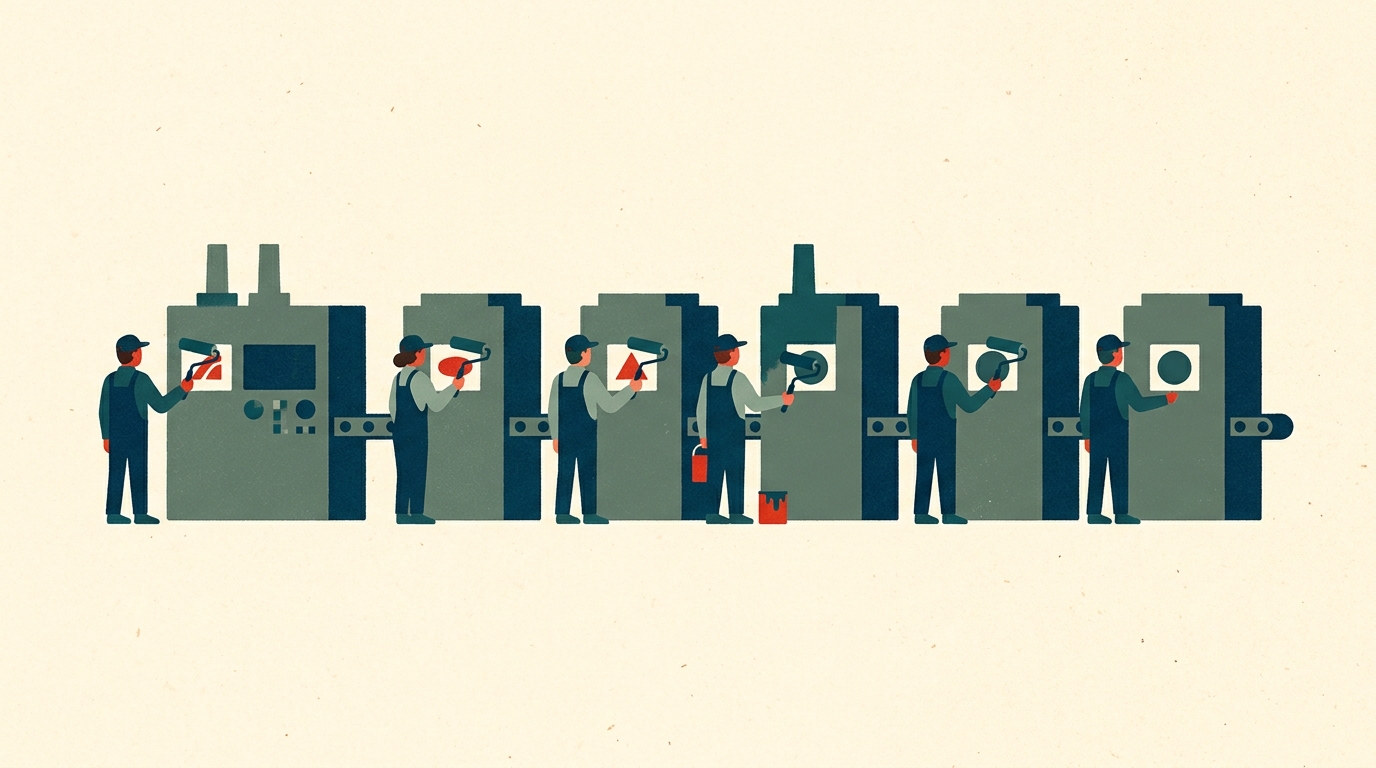
A crowded market is not a problem. Multiple companies solving different parts of a large problem validate that buyers are willing to pay.
Distinguishing crowd from convergence
The real risk is a converged market, where competitors copy-paste each other's positioning strategies until all real distinction disappears. They stop looking at their buyers and start looking only at their rivals' feature lists. The result is identical copy, and a strategy that has stopped doing any work.
They trade unique capabilities for generic claims, sounding like slightly different versions of Salesforce or Zoom while describing entirely different realities.
If your primary source of brand identity is what your competitors do, your copy will always reflect their choices instead of your own.
The failure mode of copy-pasted strategies
The playbook outlined in the Botensten guide advises brands to own one specific customer and one specific problem. Granting that this is sensible advice, it has a glaring failure mode when applied to converged categories.
When thirty competitors target the same sub-problem with the same templated sentences, the niche itself saturates. The problem is not the segment's size, but the source of the copy.
Retreating to a smaller corner is a defensive move, not a strategy.
Instead of hunting for an even smaller niche, examine the inputs that define the brand.
Why narrowing your niche in a converged market only shrinks your pipeline
The argument for hyper-niching is straightforward. By narrowing your focus, you can dominate a small segment before expanding to larger ones.
The false promise of hyper-niching
Focusing resources where there is the highest chance of winning makes sense, especially when Botensten, citing McKinsey, reports that only 22% of businesses have a clear positioning strategy.
A focused target allows a small sales team to speak directly to a highly specific set of pain points. In the short term, this focus can buy a brief head start against slow-moving incumbents.
In a converged category, this approach fails. You end up shouting corporate jargon to an even smaller, quieter room.
The niche itself becomes a prison. You have shrunk your potential pipeline while remaining completely indistinguishable from the other players who had the exact same idea.
Shouting to an empty room
A brand does not become distinct by speaking to fewer people in the same generic voice.
You cannot solve a messaging problem by shrinking your target audience. If your core message is identical to five other competitors, narrowing your focus just guarantees fewer deals — volume traded for a relevance the prospect never feels.
Map the silent spaces competitors ignore
To break out of a converged market, you must stop looking at what competitors say and start looking at what they do not say. This requires a systematic audit of the category narrative.
Finding the unclaimed territory
Distinct brand strategy is built in the silent spaces rivals ignore. You find these spaces by mapping where the category screams and where it stays silent. Most competitors crowd into the noise.
A framework from Sprinta's insights on crowded markets suggests mapping competitor claims to reveal contested and unclaimed territories. This mapping shows where everyone is fighting and where nobody has planted a flag.
If every competitor shouts about automation, the silent space might be manual control. Claiming that space creates immediate contrast.
This mapping is not a creative exercise; it is an analytical audit. You are looking for structural gaps in competitor claims that you can credibly defend.
Building on operational truth
This work is slow and analytical. Instead of inventing a fictional brand story, report the operational realities already there.
Buyers do not believe empty marketing claims. They demand verifiable evidence, which you can present by following this guide on how to prove a differentiator.
Trust comes from showing how operations solve the specific, unaddressed problems competitors gloss over.
Aligning positioning with operational reality makes the copy impossible to replicate. Competitors cannot copy your messaging without rebuilding their entire operational structure.
Avoid the high cost of category creation

When faced with a saturated market, founders are often tempted to abandon their category entirely and invent a new one. This is a high-risk gamble that most companies cannot afford.
The category creation illusion
The temptation is understandable. Narrative giants like Uber and Airbnb successfully built new categories, completely reframing how people think about transportation and lodging.
Conventional advice says if you cannot win the existing game, invent a new one. But category creation requires deep pockets and a long runway.
Most startups lack the capital to educate a market on a new term, wasting millions on category definition instead of winning customers.
Category creation is a game for the few. For everyone else, it is a fast track to burning capital on an idea buyers do not understand.
Positioning against existing needs
The practical path is to position a product as a demonstrably better way to solve an existing, well-understood problem — building on market understanding rather than trying to rebuild it from scratch. Marketbuildr's positioning walkthrough makes the same case: define the buyer's problem first, and aim to be the best answer to it rather than the most unique.
As noted by Brands by Day, companies like HubSpot frame the customer as the active participant and the brand as the guide. They do not invent new categories; they position around transformation.
Slack did not invent business communication; it offered a faster way to handle a known need.
By focusing on a specific transformation, you capture existing demand without the massive overhead of teaching buyers a new industry vocabulary.
This approach is less glamorous than category creation, but it is infinitely more capital-efficient. You let your competitors spend money educating the market, then you step in with a better solution.
How to tell if your positioning is working
Many brand teams evaluate positioning success by measuring brand awareness or tracking sentiment scores. These metrics miss the point: brand value comes from identification, not simple awareness.
Behavioral metrics over soft sentiment
Instead, rely on behavioral metrics. The Botensten guide suggests tracking three key indicators: win rates, pricing power, and how easily buyers recall the core message.
When your positioning is working, your sales win rates climb because buyers understand exactly why you are the right choice. Your pricing power strengthens because you are no longer viewed as a commodity.
Prospects will repeat the core message back to the sales team during discovery calls. When they articulate the exact difference, the strategy has succeeded.
If your team is still handling standard objections about why you are different from competitor X, your positioning has failed to perform.
The ultimate test of strategy
The final proof of your strategy is the prose itself. Look at your homepage, then look at your closest rival's homepage. If you can swap the logo and the page still makes sense, the positioning has failed.
No amount of experiential marketing or clever copywriting can save a strategy built on copy-pasted inputs.
Real differentiation requires the analytical rigor to report the operational realities that are already there and state them plainly.
Go back to that grid of twelve. Stop looking for a smaller corner of it to hide in. Map the silent spaces, build on operational truths, and write the copy no other company on that grid could sign.
Frequently asked questions
- What is the difference between brand positioning and category positioning?
- Category positioning defines the specific market segment and job your product performs. Brand positioning is the strategic reason a buyer chooses your specific company over competitors who solve that same problem. One outlines the playing field, while the other decides why you win on it.
- Is it better to create a new category or position against an existing one?
- For most companies, positioning against an existing category is the more practical path because category creation requires deep pockets and an exceptionally long runway. Leveraging existing market understanding allows you to focus on demonstrating a clearly superior way to solve a known problem.
- How do you solve a message saturation problem when a market is crowded?
- You solve it by systematically mapping what your competitors claim and identifying what they are silent on. Durable positioning is built in this unclaimed territory by owning a specific, unaddressed customer problem rather than fighting for the generic claims everyone else makes.
- How do you measure the success of a crowded category positioning strategy?
- You measure positioning success through concrete behavioral metrics rather than soft sentiment. The most reliable indicators are an increase in win rates, stronger pricing power, and high message recall among prospects during sales conversations.
Sources
- How to Position a Product in a Crowded Market — botensten.com
- How to Position a Product in a Crowded Market — sprinta.co
- How To Position Your Startup To Grow In A Crowded Market — marketbuildr.com
- Brand Positioning in Crowded Markets: What Still Works — brandsbyday.com