Guides
The Cost of Brand Sameness and How to Audit Your Copy
B2B brand sameness is the logical result of risk-averse benchmarking. Learn how to run a copy audit, diagnose linguistic mimicry, and write messaging buyers actually notice.
Ines Calloway
Sep 2026 · 7 min
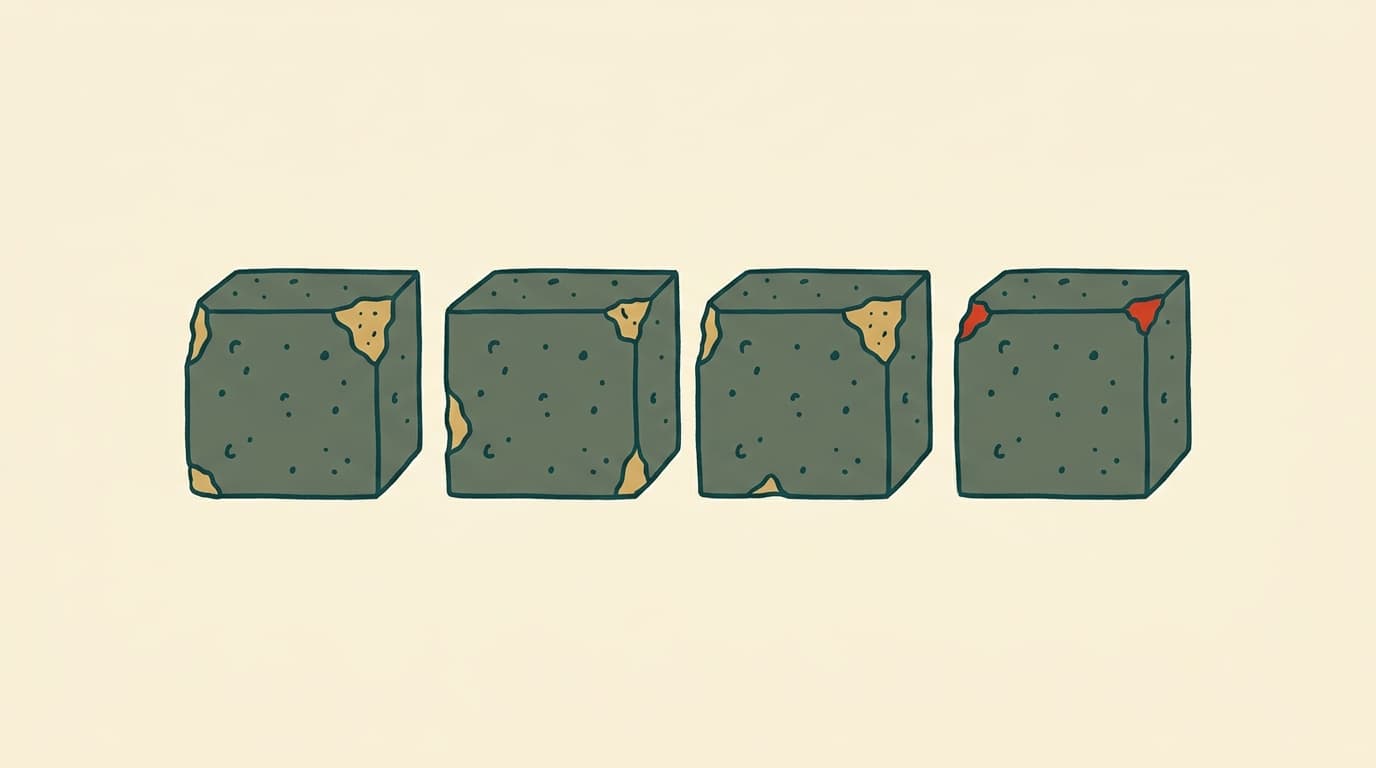
Standard B2B marketing advice suggests benchmarking your messaging against category leaders. This practice is the fastest route to commercial invisibility. Copy the category template and you vanish.
Buyers do not choose between options they cannot tell apart. They simply ignore the entire sector. To stand out, stop inventing fictional differentiators and audit the language you publish.
The comfortable middle of category messaging
The creeping suspicion of identity theft
Most marketing leads experience a quiet moment of doubt looking at their website. Swap your logo with a competitor's. If the homepage still makes sense, you have a structural problem.
This is not a failure of talent. It is the logical result of corporate risk aversion. Teams want to sound professional, so they use the vocabulary they hear around them.
This vocabulary is a security blanket for executive teams. It feels comfortable because others validated it first. What feels safe in the boardroom is useless in the market.
Standard risk aversion as a structural trap
This convergence is brand sameness. When you write to minimize risk, you write what is expected.
The expected is easy to approve in meetings, but impossible to remember.
When you reduce the friction of internal approvals with familiar phrasing, you shift that friction to your buyers. They must now do the work of figuring out what you do.
Most buyers will not bother to do that work.
Defining the sea of sameness
The difference between consistency and imitation
Two concepts are often confused. Brand consistency means delivering a recognizable, distinct voice across every touchpoint.
Brand sameness in marketing is an identity that looks like everyone else from day one. Consistency builds trust. Sameness ensures you never get the chance.
When a company cannot define its unique value, it defaults to the industry standard. This is not positioning. It is simply matching the background noise.
Formulaic language and the "Find your X" trap
Marketing strategist Tom Roach describes this category collapse as the stupidity of sameness. He points out how brands drop into identical linguistic formulas.
In digital service categories, dozens of competitors default to the same phrasing: “Find your X” or “Streamline your Y.” These formulas are regional dialects. They sound familiar inside the company, but they communicate nothing to the buyer.
In 2017, researchers at BBH Labs analyzed this pattern and found at least 27 brands using the same “Find your X” formula.
This is the sea of sameness, where copy goes to die. When every competitor promises the same outcomes with the same structure, buyers choose on price alone.
Why smart teams build identical brands
The benchmarking loop
Mimicry rarely starts with a desire to copy. It starts with competitive analysis. Teams collect competitor homepages and average the common themes into a new corporate standard.
This approach replicates the errors of your competitors. When everyone executes the same playbooks, challenger brand strategies fail before reaching the market.
You cannot challenge a leader by acting like their junior partner.
Sourcing failures in strategy
The underlying cause is a failure of raw materials. When your strategy team relies on the same templates and third-party reports, they arrive at the same middle.
Thin inputs converge. If you feed your strategy the same data your competitor uses, your positioning will look exactly like theirs.
The strategy falls flat the moment a buyer opens a second browser tab.
How AI-driven content accelerates commoditization
The high-speed average
The rise of AI-driven content turned this slow convergence into a high-speed pileup. Because generative models are trained on the existing web, they are mathematically bound to produce the category average.
When teams use these tools to generate bulk copy, they source their brand voice from the middle of the category. They are publishing the average.
AI accelerates this race to the bottom by making average copy free. When the cost of generic text drops to zero, the volume of identical messaging grows.
When the tool defines the voice
Automated drafting creates a credibility gap. If your product claims to be different, but your copy reads like a generic template, buyers notice the contradiction.
Your copy is the direct proof of your competence. If it reads like an average of the web, it refutes whatever value your sales team is pitching.
It tells the buyer you have nothing original to say.
A diagnostic test for linguistic mimicry
The blind test
You can diagnose your copy in three steps. First, run the blind test.
Paste your homepage text into a plain document without logos or brand names.
Hand this document to your sales team. If they cannot distinguish your proposition from a competitor's, your messaging has failed.
If your own employees cannot identify your voice without a logo, your buyers certainly will not.
Here is what the test looks like when it fails.
Two paragraphs, written in the style every B2B service homepage converges on:
“We partner with ambitious teams to deliver seamless, end-to-end solutions that drive measurable growth. Our collaborative approach means we are invested in your success from day one.”
“We work alongside forward-thinking businesses to build integrated solutions that deliver real results. Our partnership model means your goals become our goals.”
One of those companies builds warehouse software. The other does executive recruiting. Nothing in either paragraph tells you which is which, or what either one actually sells.
Now the same test on copy that passes:
“If a pallet is mislabeled at 4pm, your shipment misses the cutoff and your customer hears about it before you do. We make sure that does not happen.”
You know what that company does. You know who it is for. You know what goes wrong without it. One sentence, no adjectives.
The forbidden word list
Second, audit your copy for standard B2B vocabulary. Look for words like “all-in-one,” “seamless,” “streamline,” and “innovative.”
These words do not carry meaning. They are placeholders where a concrete customer outcome should be.
A warehouse manager whose inventory database just crashed does not care about a “streamlined interface.” They want to know if their shipping labels will print tonight.
When you use these words, you tell the buyer you have not done the work to understand their day-to-day problems. You are using category jargon to hide a lack of specific insight.
Source verification
Third, trace where your copy's insights originated. Did they come from raw customer interviews or a competitor's feature list?
If the source is a competitor's website, your copy will converge on their positioning. True differentiation requires looking at the transactions happening in your business today.
You must speak with the customers who use your product to solve real problems. Their feedback is the raw material for copy that stands out.
This is the step teams skip, and it is the one that decides the outcome.
The other two tests are diagnostic. They tell you your copy is generic. This one tells you why, and the answer is almost always the same: the inputs were generic before the writing started.
A strategy assembled from competitor homepages, category reports, and a model trained on both cannot produce anything but the category average. The output is downstream of what you fed it. No amount of editing at the end recovers a claim that was never in the raw material.
So audit the inputs, not just the copy. For every claim on your homepage, name the source. A customer said it on a call. A support ticket surfaced it. A delivery record proves it. If the honest answer is that it came from a competitor site or a whiteboard in a workshop, that claim is not yours, and it will not survive contact with a buyer.
Claims with a source behind them are the only ones a competitor cannot copy by editing their homepage.
The price of becoming invisible to buyers
Cognitive filters and category avoidance
The cost of similarity is financial, not aesthetic.
Human brains filter out repetitive stimuli to prevent cognitive overload. Research by Theory SF shows that buyers do not choose between identical brands; they ignore the entire category.
Your competitor is not the startup down the street. It is inertia.
When buyers face three identical options, they default to doing nothing because the risk of making the wrong choice feels too high.
Memory decay and market leaders
The LinkedIn B2B Institute explains this through the Von Restorff effect. The principle states that distinctive items are remembered, while similar ones disappear.
If your brand sounds exactly like the category leader, the buyer's brain will attribute your marketing efforts to that leader.
You are spending your own budget to build their pipeline.
Digging up the story that is already there
Excavation over invention
The fix for brand sameness is not inventing a clever tagline. Cleverness is just another way to sound like everyone else.
The strategist's job is to report the brand that already exists. You do this by looking at how your customers use your product.
The work is excavation, not invention. Stop trying to author a brand story and start reporting the one your customers are already telling.
The language of transactions
Real differentiation is built from the customer realities you encounter every day. It comes from the language customers use when they describe why they bought your software.
You do not need to invent a narrative when you can simply dig up the story playing out on your sales calls.
Truth is always more specific than fiction.
The choice between safety and identification
Spending on recognition that pays off
Building a brand is expensive, but simple awareness is a low bar. The real return comes from identification.
Buyers need to recognize their specific problems in your voice. They will not align themselves with a company that sounds like the rest of the category.
Your diagnostic next steps
If you suspect your brand is lost in the sea of sameness, do not commit more budget to distribution before fixing the source.
Run the blind test on your last three marketing campaigns. Look at the language on your homepage next to your top competitor's page.
If the words swap cleanly, stop drafting. Look at your transactions to find the specific customer truth, then write copy nobody else can claim.
Frequently asked questions
- What is brand sameness in marketing?
- Brand sameness occurs when companies in the same sector use identical language, positioning frameworks, and design choices. When organizations benchmark their messaging against competitors instead of finding their own strategic truth, they converge on a shared category vocabulary.
- Why is brand sameness a strategic risk?
- Sameness turns your marketing invisible because human brains are wired to filter out repetitive information. If your copy mirrors your competitors' value propositions, buyers will ignore your category entirely or choose based solely on price.
- What is the difference between brand consistency and brand sameness?
- Consistency means delivering a distinct, recognizable identity across every channel you own. Sameness means that your starting identity is indistinguishable from every competitor in your category.
- What is the sea of sameness?
- The sea of sameness is a marketing condition where every brand in a vertical relies on the same templates, messaging structures, and copy patterns. The result is a highly saturated market where no single brand stands out to decision-makers.
Sources
- Why is brand sameness a strategic risk for businesses in 2026? — kingofhearts.be
- The stupidity of sameness and the value of difference – Tom Roach — thetomroach.com
- The Sea Of Sameness — business.linkedin.com
- The Sea of Sameness in Marketing: Why Most Brands Become Invisible — Theory SF — theorysf.com