Brand in the age of AI
Brand Matters More in the Age of AI, Now Polish Is Free
AI hands every company the same competent marketing on request, so polish stops setting anyone apart and what a company stands for carries more of the weight.
By Ines Calloway · October 22, 2026 · 7 min read
A marketing team asks a model for a new homepage and has a clean, confident draft by lunch. The competitors who asked last month got nearly the same page. Brand matters more in the age of AI for exactly that reason: the tools that made this draft make everyone's.
Execution used to separate companies. A sharp website or a well-made campaign took money and skill, so polish said something on its own. When anyone can produce polish on request, it stops saying anything, and buyers are left comparing what each company stands for.
Cheap, competent execution pulls every company toward the same middle
A model can make almost anything look competent and current, so almost everything does. The floor for marketing work has risen, and the odds that any one piece stands out have dropped.
The reason is how these tools work. A model draws on what's already been published, weighted toward whatever appears most often. Ask it to position a company with nothing else to go on and you get the average of that company's market.
Every competitor who does the same gets that average too, and the market converges on one message.
Features offer little protection. A competitor can ship what you launched by the next day. Two advantages stay hard to copy: data that only you hold, and a brand buyers know for something specific.
A study of short stories shows how a whole field converges
In a 2024 study, Doshi and Hauser asked people to write short stories, some of them with ideas generated by AI. The University of Exeter's release on the research reports that the AI-assisted stories were judged more creative, better written and more enjoyable.
The cost showed up across the group. "AI-assisted stories were found to contain more similarities to each other and were less varied and diverse," the release says. The researchers "found a 10.7% increase in similarity between writers whose stories used one generative AI-idea."
Doshi put the trade-off plainly: "While these results point to an increase in individual creativity, there is risk of losing collective novelty." A market full of competitors drafting with the same tools behaves like those writers taken together.
These were short stories written by study participants, with no marketing teams or brand copy involved. Read the study as an analogy for what happens to a market. Showing the same effect in marketing copy would take a study of marketing copy.
Switching to a different model won't stop the convergence either. A 2025 paper on creative sameness across models by Wenger and Kenett found that "LLM responses are much more similar to other LLM responses than human responses are to each other."
Different models drift to similar answers, so the fix has to come from what a team puts into the model.
Your competitors' copy already shows which promises are used up
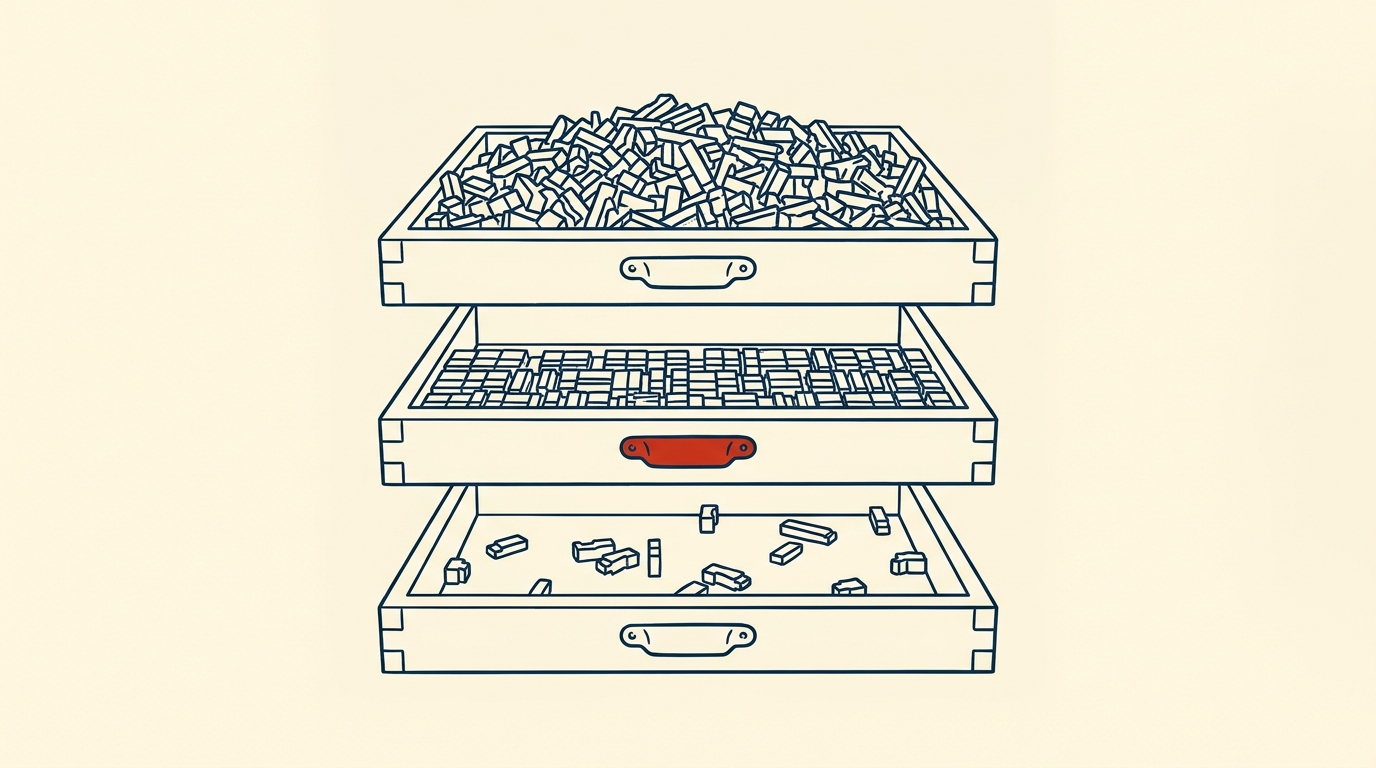
Brand differentiation in the age of AI starts with an honest look at how alike you already sound. Collect the headline promise and main selling points from each competitor's homepage, and put your own in the same list.
Then label each selling point by the job it does for the buyer, count how many companies make it, and sort it into one of three piles: everyone says it, some say it, or nobody says it.
Say a firm runs commercial cleaning for office buildings. Every competitor promises reliable service and trained staff, so those go in the first pile. A few mention eco-friendly supplies, which puts that in the second. Nobody promises a nightly report of what was cleaned and what was missed, so that sits in the third.
The first pile is ground the firm can't win on, and it's exactly where a model will drag its copy, since those are the phrases it has seen most. The second pile is contested; the firm would have to out-prove the others there. The third pile is the only place a position has room to live.
Our guides on reading a competitive messaging audit and finding white space in a converged market go deeper on the sorting.
Narrowing to a niche is one response to sameness, and often a sound one, since a tighter market makes marketing and sales more efficient. It won't fix sameness by itself, because a narrow market converges too. Whether to narrow is a trade between growth and profitability, and the call belongs to whoever sets the company's goals.
People inside the company have to decide the starting point
Brand strategy in the age of AI starts with a few words that settle two things: what market you're in and what you promise. Decide those in-house, by people, before any model gets involved.
Those few words end up behind almost everything. They get run through a model thousands of times across a company, in every sales email and service page. If they're generic, each piece built on them drifts a little further from anything that belongs to you.
A model can only average what already exists, so it can't be where the starting point comes from.
Will branding be replaced by AI? The tools can draft much of what comes after the decision. The decision itself, the market and the promise, still needs people who know what the company believes and can prove.
Sameness often sets in before any tool is opened. Teams read the same research and follow the same industry voices, and their thinking slides toward one middle. A model handed that thinking, or a bare request for a landing page, gives the middle back.
With your decisions and proof, AI speeds up your own brand
Once the starting point is set, the tools become useful. Hand a model the market and promise you decided on, along with the evidence that backs the promise. Then add your view of how your market works, the point of view a model can't infer from anyone else's website.
For the cleaning firm, that means service pages drafted from the nightly-report promise and the proof behind it. Starting from the phrase "commercial cleaning services" would land it back in the first pile.
A model is fast whatever you feed it.
With your decisions and proof, it gets you to a brand of your own sooner. With a bare request, it gets you to the same average every competitor is drafting, just as quickly. Switching models won't change that, since they converge on similar answers. What you hand the model is the part you control.
Being known for something is what lasts once features can be copied
When a rival can match a feature by tomorrow, the edge that holds is being the company buyers think of for one specific thing. It has to be proved in a way buyers believe, and once it's built, a competitor has no quick way to copy it.
The product-first case holds until a rival ships your feature
Plenty of companies grow fast on a great product and a forgettable brand. AI makes great products easier to build, so the argument goes that brand spending is optional: let the product win.
That's a fair reading of a lot of growth stories. Many of those companies succeeded in spite of their brand, and skipping brand work feels safe because every day so far has been sunny.
The weather changes when a competitor can ship your feature tomorrow. The product stops being the difference, and buyers with nothing else to go on fall back on the cheapest or the safest option.
How much to invest in brand still depends on your goals. Betting that the product will stay unmatched is a harder bet than it used to be.
If you'd like to look at where your own promises fall across those three piles, or what your market's worn-out language means for your brand, get in touch and we can talk it through.
The next homepage draft will come back by lunch whichever words go in. Whether it sounds like you depends on the ones your own people chose first.
Frequently asked questions
- Does brand matter in the age of AI?
- Yes, more than it did. AI tools give every company the same competent, polished marketing, so polish stops separating anyone. Two advantages stay hard for a rival to copy: data only the company holds, and a brand buyers know for something specific.
- Is branding going to be replaced by AI?
- The tools can produce much of the work that comes after the core decision. Deciding what market you're in and what you promise still needs people who know what the company believes and can prove, because a model can only average what already exists.
- How do you differentiate a brand when competitors use the same AI tools?
- Collect each competitor's headline promise and main selling points next to your own, label each point by the job it does for the buyer, and sort it by whether everyone, some or nobody makes it. The promises everyone makes are where AI will pull your copy, and the ones nobody makes are where a position has room.
- Does switching AI tools stop marketing from sounding the same?
- Switching tools doesn't help much. A 2025 paper by Wenger and Kenett found that responses from different models are much more similar to each other than human responses are. What changes the result is what you give the tool: your chosen market and promise, the proof behind it and your view of how your market works.
- Should a company with a great product still invest in brand?
- Many companies grow on a great product and a forgettable brand. When a competitor can ship the same feature the next day, the product stops being the difference, and buyers with nothing else to go on fall back on the cheapest or safest option. How much to invest still depends on the company's goals.
Sources
- AI found to boost individual creativity – but results in less varied content — University of Exeter, July 2024
- We're Different, We're the Same: Creative Homogeneity Across LLMs — arXiv, January 2025